The Staffordshire Bull Terrier

A breed apart...

The Staffordshire Bull Terrier Standard can be found by accessing the Australian National Kennel Council (ANKC) website, along with the standards of all other breeds. - www.ankc.org.au
ANKC Staffordshire Bull Terrier Standard:
(as found at: http://www.ankc.org.au/Breed_Details.aspx?bid=71)
| Group: | Group 2 (Terriers) |
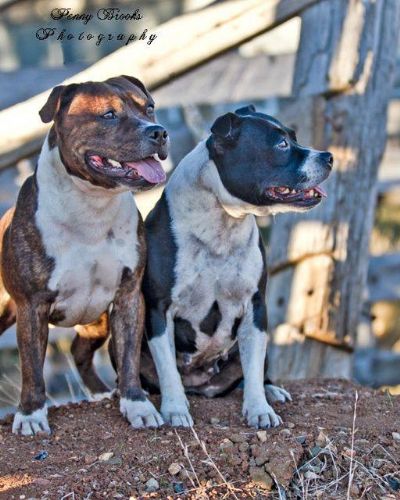
| General Appearance: | Smooth coated, well balanced, of great strength for his size. Muscular, active and agile. |
| Characteristics: | Traditionally of indomitable courage and tenacity. Highly intelligent and affectionate especially with children. |
| Temperament: | Bold, fearless and totally reliable. |
| Head And Skull: | Short, deep though with broad skull. Very pronounced cheek muscles, distinct stop, short foreface, nose black. |
| Eyes: | Dark preferred but may bear some relation to coat colour. Round, of medium size, and set to look straight ahead. Eye rims dark. |
| Ears: | Rose or half pricked, not large or heavy. Full, drop or pricked ears highly undesirable. |
| Mouth: | Lips tight and clean. Jaws strong, teeth large, with a perfect, regular and complete scissor bite, i.e. upper teeth closely overlapping the lower teeth and set square to the jaws. |
| Neck: | Muscular, rather short, clean in outline gradually widening towards shoulder. |
| Forequarters: | Legs straight and well boned, set rather wide apart, showing no weakness at the pasterns, from which point feet turn out a little. Shoulders well laid back with no looseness at elbow. |
| Body: | Close coupled, with level topline, wide front, deep brisket, well sprung ribs; muscular and well defined. |
| Hindquarters: | Well muscled, hocks well let down with stifles well bent. Legs parallel when viewed from behind. |
| Feet: | Well padded, strong and of medium size. Nails black in solid coloured dogs. |
| Tail: | Medium length, low set, tapering to a point and carried rather low. Should not curl much and may be likened to an old fashioned pump handle. |
| Gait/Movement: | Free, powerful and agile with economy of effort. Legs moving parallel when viewed from front or rear. Discernible drive from hindlegs. |
| Coat: | Smooth, short and close. |
| Colour: | Red, fawn, white, black or blue, or any one of these colours with white. Any shade of brindle or any shade of brindle with white. Black and tan or liver colour highly undesirable. |
| Sizes: | Weight: Dogs 13-17 kg (28-38 lbs) at withers Bitches 11-15.4 kg (24-34 lbs) at withers Desirable Height: 36-41 cms (14-16 ins) (these heights being related to the weights) |
| Faults: | Any departure from the foregoing points should be considered a fault and the seriousness with which the fault should be regarded should be in exact proportion to its degree and its effect upon the health and welfare of the dog. |
| Notes: | Male animals should have two apparently normal testicles fully descended into the scrotum. |
************************
Health
Staffordshire Bull Terriers are considered a generally healthy breed. They can live up to 12-14 years, but they have been known to live past that. Thus, before purchasing a Stafford you must consider the life-long committment you must make to your dog.
A responsible breeder takes into account the genetic diseases that can affect our breed. Therefore, when purchasing a puppy from a registered, ethical breeder, never be afraid to ask about their dogs, their breeding practices, nor be afraid of INSISTING to see health certificates, or requesting copies.
If both parents are clear of common breed related afflictions, their pups will generally be clear of the disease by parentage. Certificates should be readily avaliable for viewing when purchasing a dog.
The genetic diseases that affect the Staffordshire Bull Terrier are;
- L2HGA - This disease affects the central nervous system. Symptoms can be apparent from as young as 6 months of age. Genetic testing is avaliable.
- Hereditary Cataracts (HC) - Affected dogs develop cataracts at a young age, often resulting in blindness. Genetic Testing is avaliable.
- Distichiasis - Extra hairs grow on the edge of the eyelid and rub against the corneal surface of the eye. Responsible breeders breed away from this issue, but it can be surgically corrected.
- Entropian - A varying amount of hair-covered eyelid rubs against the eye making this extremely painful for the dog. Responsible breeders breed away from this issue, but it can be surgically corrected.
- Persistent Hyperplastic Primary Vitreous (PHPV) - A developmental issue in the eye, it may lead to blindness. Testing carried out on individual animal.
- Hip Dysplasia - This condition can lead to varying degrees of arthritis, which may then cause pain or debilitation. No genetic testing avaliable, but hip scores can be taken on individual animals.